


Talking with a designer of Spyro: Year of the Dragon is talking to an artist. One of the few series that has ever managed to bridge the gap between young and adult entertainment, Spyro appeals to all ages with its bright and colourful graphics and tight gameplay. We got a chance to talk with Ted Price of Insomniac Games about making the game, what it's all about, and future plans.PSi: How and when did you become involved in the Spyro project(s)?
TED: After we had finished Disruptor for the PlayStation in 1996, we had around six people at Insomniac Games and we were trying to figure out what we wanted to do next. We knew that we wanted to do a 3rd person game with a more light-hearted feel than Disruptor and that the age of the average PlayStation consumer was decreasing. After a couple of weeks of brainstorming, we came up with the beginnings of the Spyro concept and began developing the character and the engine.PSi: Why Spyro: The Year of the Dragon? What prompted the Oriental flair?
PSi: How long did it take to develop and complete Spyro: Year of the Dragon?TED: Since 2000 IS the Year of the Dragon, it just made sense. Naming a game can be one of the tougher challenges (believe it or not) in the development process - especially when it is as high profile as Spyro. You've got lots of people who are already attached to the character or the gameplay and nothing really seems right. Looking back on the original Spyro, we went round and round for months on the name until Ami Blaire, director of product marketing at Sony suggested Spyro. Even then, it took folks a while to get used to it. Now though, I can't imagine calling Spyro by any other name (except "Pete" perhaps..)
PSi: What do you like best about the way the game turned out?TED: We began development in November 1999 and finished the U.S. version in mid-September 2000 so that would be about 10 and a half months. With the exception of the last month in the project, this was the smoothest production cycle that we've ever had. I think that the two previous Spyros really helped us nail down a production pipeline that works well for this team.
TED: Everyone you ask on the team will probably have a different answer since there are so many new features for Spyro Year of the Dragon, but personally I believe that the five new playable characters were a real coup for us. We spent a lot of time trying to come up with critter designs that were well-balanced and whose gameplay style didn't overlap and I think that we succeeded. The fifth playable character - Sparx, also turned out great with his old school Gauntlet-type levels.PSi: What do you most wish you could have done differently, if anything?
TED: Given the time constraints we were under - nothing. But when you take deadlines and release dates out of the picture, the answer for this is always the same for us - add more stuff! Despite the fact that this game is twice as big as the last two Spyros, we STILL wanted to add more at the end. Spyro is such a great character and we had so many ideas for minigames and general bells and whistles that it was hard for us to stop creating cool stuff.PSi: What other games gave inspiration to the style of play in the newest Spyro?
PSi: In the first two outings of the series, you controlled only Spyro. In Year of the Dragon, there are a multitude of friends that you get to play with as well. Why the switch?TED: When you look at the huge variety of minigames in Spyro Year of the Dragon you should be able to tell where we got a lot of our inspiration: Tony Hawk, Doom, Scramble, Gauntlet, Goldeneye, Robotron, Virtua Cop, Mario Kart, Crash Bandicoot, Ready to Rumble, Mario 64, Rampage, to name a few. We also plagarized from ourselves - taking some of the minigames from Spyro 2 and improving them dramatically. For instance, the hockey game from Spyro 2 morphed into the Cat Hockey minigame in Spyro Year of the Dragon. I think though that we had a LOT of purely original minigames in the latest Spyro and I hope that we're able to inspire other developers in the future.
TED: Instead of burdening Spyro with a bunch of extra moves, we wanted players to experience new control schemes AND introduce new faces. The best way to do this was through the critters. Since all four are so different we believe that we created a much greater variety of gameplay by using them versus sticking with Spyro.PSi: What inspired the unique, Gouraud-shaded stylings of the Spyro universe, as opposed to the typical texture-heavy fare of most platformers?
PSi: How do you decide what minigames to put into the game, and similarly, how do you come up with the minigames themselves? Are the levels designed around the games, or vice versa?TED: When we created the first Spyro, we found a couple of pastoral images in fantasy art books that stood out because of their vivid, cheerful palette. We wanted to create a bright, saturated fantasy world that wasn't cartoony so we used those pictures as a platform to develop the art style. We also realized that by employing vertex coloring and using textures that had a "softer", more hand-painted feel, we would be able to create a style that was unique on the PlayStation. Another of our original goals was to create panoramic views in our environment which meant multiple levels of details for our models. Since the low-poly versions of these models were not textured, but Gouraud-shaded, it enhanced the game's "softer" feel. This time around, we've increased the saturation and "punch" in our colors and textures so that the environments are even more vivid than they were in the previous Spyros.
TED: The design process on this Spyro was very collaborative. We asked everyone to come up with ideas for the minigames and give them to the level designers. In fact, we had a LOT of brainstorming meetings which involved people from each discipline at Insomniac - designers, programmers, background artists and animators. It was up to Caroline, Brian and Michael (the level designers) though to decide which minigames went into their levels. The levels really weren't designed around the minigames. They were designed around the primary route to the exit and then we added the minigame areas which had the same production design flavor.PSi: How do you balance appeal to both children and adults? Just with sly humour, a la The Muppet Show, or is there more to it?
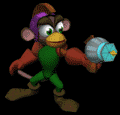 | TED: One of the ways we did it this time was to introducte the Active Challenge Tuning (A.C.T.) system.. A.C.T. is a system that Brian Hastings, our VP of Programming, invented to even out the gameplay difficulty curve for players of different abilities. Without going into details, A.C.T. is designed to sense how well a player is doing and interactively "tune" the game's difficulty so that the hardcore players are constantly challenged and so that the novice players don't get frustrated. It really is an amazing system and most players will never know that it's there, working in the background. |
TED: Despite the fact that we created Spyro, this is our last outing with the diminutive purple one on any platform. You may be seeing him again, but we won't be the ones doing it. We're moving on to bigger and better (and top-secret) things on the PS2! Stay tuned...

